This page has been idle for a while. To make sure you don't miss out on the latest content, please reload the page.Refresh
Refresh
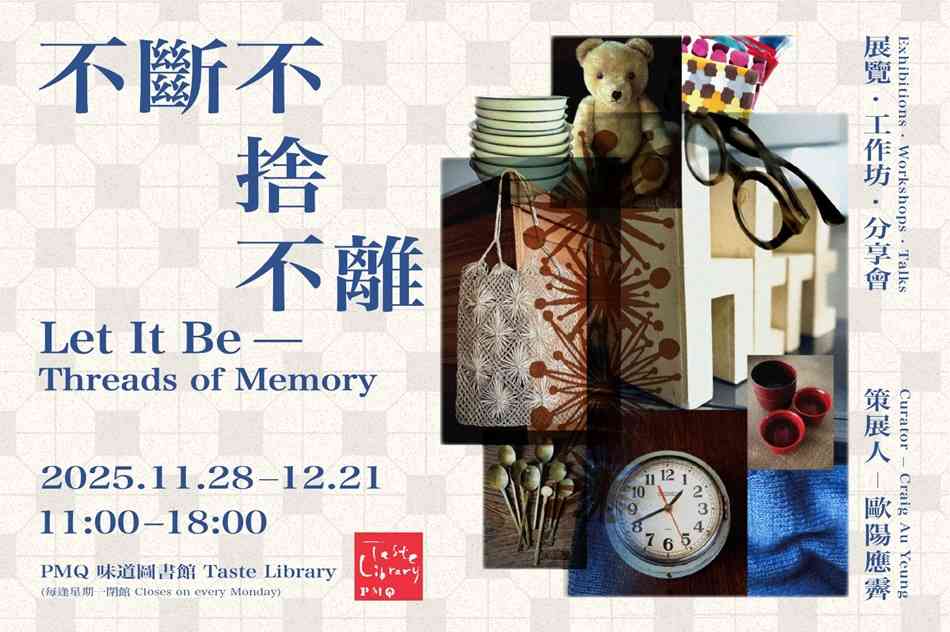


Since the lifestyle aesthetic concept of 'danshari' (a Japanese term meaning 'refuse, discard, detach') emerged and gained popularity, people have started to re-examine their relationships with their possessions and living spaces, even changing their lifestyles and attitudes, opening up new dimensions in their daily lives. Senior cross-media creator and all-round food and lifestyle connoisseur Au Yeung Ying Chai (A Chai) had a revelation about the idea of 'keep, cherish, preserve' while consolidating and documenting his possessions! This thought was then compiled into a book and further extended into an exhibition – 'Keep, Cherish, Preserve'! The exhibition is held at PMQ, The Mills' 'Taste Library' from now until 21 December. Apart from displaying 31 items that Au Yeung and his friends from the cultural and design industries 'cannot detach from', along with intimate sharing of the stories behind them, there will also be multiple workshops during the period to explore the concept of 'keep, cherish, preserve' with the audience from different angles.
In addition, Au Yeung will meet with the public on 21 December, the last day of the exhibition, to focus on and further promote this concept, which is both profound and close to life, and also preview the future plans for the 'Three Keeps'.
Keep, Cherish, Preserve: A Tribute to 'Danshari'
'Keep, Cherish, Preserve' is not a contradictory statement but Au Yeung Ying Chai's tribute to the advocates and practitioners of 'danshari'. Unlike the general simplistic and frivolous understanding of 'danshari' as 'organising' or 'throwing things away', Au Yeung previously documented 66 items that had grown up with him one by one in words and pictures, re-examined the concept of 'danshari', and realised the idea of 'keep, cherish, preserve', and sorted out a concrete practice method:
'Keep' refers to examining the different states of possessions at different times, seeking a way to connect the past, present, and future.
'Cherish' refers to exploring the relationship between people and objects, trying to use restoration methods to achieve sustainability.
'Preserve' refers to using the cleanest and neatest craftsmanship and technology to properly archive and preserve the possessions around us.
The so-called 'keep, cherish, preserve' is actually a safeguard for 'danshari', reminding oneself to reflect deeply and carefully sort out the complex entanglement between people and their current possessions before taking 'tidying up' action, as well as the almost forgotten people, things, and memories. After a soul-searching self-examination, one's current outlook on life, values, aesthetic standards, emotional intelligence, etc. will also be revealed, making the decision to embrace the new or stick to the old more affirmative.
The significance of 'keep, cherish, preserve' is the coexistence and regeneration of people and objects. Au Yeung believes that in an era full of changes and impermanence, we need to take the initiative and lead our own thinking and judgment, and promptly record the people, emotions, objects, and events around us, being responsible for ourselves.
18 Cross-disciplinary Creators, A Selfless Sharing Party
The 'Keep, Cherish, Preserve' exhibition will be divided into four parts: 'Clothing', 'Food', 'Toys' and 'Daily Necessities'. In addition to sharing many pieces of clothing, tableware, toys, and daily necessities that he treasures as jewels, Au Yeung also invited a group of friends to bring their 'inseparable' possessions and personally write about the touching stories behind them. The 17 friends come from different sectors, but they share a common love for creation, a passion for experiencing life, and a greater passion for sharing. They include renowned image consultant and designer Lau Tin Lan, film art director Man Lim Chung, spiritual healing therapist and writer Sue Black, independent exhibition producer Chan Long Ching, Hong Kong food programme host Andy Dark, and more. Au Yeung and his friends will be present at the exhibition venue during the exhibition period to share the stories of 'keep, cherish, preserve'; the exhibition is both an exhibition and a private sharing session of memories and emotions.
Exhibition Highlighted Artefacts and Sharing Include:
Bead Game – Lau Tin Lan (Renowned Image Consultant, Designer, Fashion Guru)
'The cardboard box is so old that it is falling apart, several white beads are missing from the bead game, and the substitutes are yellowed paper balls, but Miss Lau cherishes this 1960s bead game as a treasure. On the six-pointed star game board, the beads roll and store the childhood of the years, happily reminiscing about the simplicity.'
Bowl – Ho Sau Ping (Media Person, Writer)
'At the turn of the 20th and 21st centuries, my friend Au Yeung Ying Chai and several of his brothers opened a homeware store called 'HERE'. I fell in love with this bowl at first sight among the many exquisite products and bought it back to San Francisco, then brought it back to Hong Kong, and it has been in the top spot among my bowls for many years. This bowl that has accompanied me through warmth and cold and tasted the sour, bitter, spicy and sweet will also accompany me for the rest of my life, never leaving or forgetting.'
Small Plate for Cat Eating Chicken Fillets – Sue Black (Spiritual Healing Therapist, Writer, Director of Heart Resonance Healing Advisory)
'In 2017, my black cat left. He accompanied me for the hardest nine years of my life. Thinking back, I have never lived the way he lived. After he left, I wanted to personally experience the stubbornness of eating only chicken fillets every day for nine years. So I used his small plate and finished the two packs of chicken fillets he left behind.'
Small Hammer – Man Lim Chung (Film Art Director, Director)
'My father didn't leave many things behind, but there are a few tools he often used that I can't bear to throw away, like this small hammer, which is my favourite. I remember my father teaching me that using a hammer is not just about hitting it hard, but about using different strengths to achieve different effects, sometimes gentle and sometimes forceful. Perhaps the metal hammer part may come off due to excessive force, how can it be reassembled with the wooden handle? Also, the middle of the handle is darker due to long-term hand sweat or hand oil, which especially reminds me of my father's hands when he was working, which were strong, precise, and warm.'
Giant Egg Whisk – Andy Dark (Hong Kong Food Programme Host, Culinary Instructor)
'In addition to pursuing taste, I am also fascinated by food-related stories. By chance, I started an interview series on my social media platform at the beginning of this year, and I took out a giant egg whisk that I used when I was in culinary school, hiding it in the depths of the cabinet, and used it as a microphone to uncover chefs' and internet celebrities' insights, experiences, and small stories about food and drink.'
Grass-woven Net Bag – Au Yeung Ying Chai (Senior Cross-media Creator, All-round Food and Lifestyle Connoisseur, PMQ Taste Library Curator)
'These grass-woven net bags from the banks of the Amazon River in Brazil caught my eye with their clean and crisp patterns and strong contrast of dense and sparse lines. The style is original, rough, and powerful, and they are definitely wonderful works of art worthy of a craft and art museum! But what is even more shocking is that the retail price of each net bag is less than HK$10! This is what a real luxury item is!'
A Series of Workshops to Explore People, Emotions, Events, and Objects from Multiple Angles
During the exhibition, Au Yeung will hold a series of fascinating workshops with guests, exploring the relationships between everyday objects, design pieces, and ourselves from different angles such as food, healing, design, and Japanese object cherishing and organising: How do the objects around us establish emotional connections and exert healing power? In the era when 'danshari' is widely popular, how can designers create in a timely manner? Is the Japanese attitude of cherishing objects and organising the true embodiment of 'keep, cherish, preserve'? All kinds of issues related to 'keep, cherish, preserve' will be discussed with the audience in the workshops.
Continuing the 'Three Keeps' Spirit
On 21 December, the last day of the exhibition, Au Yeung will meet with the audience to summarise the concept of 'keep, cherish, preserve', but this does not mean the end! Au Yeung believes that the idea of 'keep, cherish, preserve' still has infinite inspiration and extension in our daily lives and life journeys. Following the latest book of the same name, 'Keep, Cherish, Preserve', and this exhibition, he will continue to promote the concept of the 'Three Keeps' and exchange ideas with people from all walks of life. Various interesting and wonderful plans related to the 'Three Keeps' are still in progress, so stay tuned.
Danshari or keep, cherish, preserve? Au Yeung Ying Chai believes that under the blessing of the God of Small Things, everything has its value, but the most important thing is to live seriously and deeply understand the meaning of yearning.
























![Central PMQ|Japanese Arts & Crafts Exhibition – Lets the Crafts Bring color to your life [Atelier DENSAN POP UP]](https://img.etnet.com.hk/customcover/event/2025/11/06/06112025_atelier_cover_m.jpg)













![Shatin New Town Plaza | Over 40,000 sq.ft. of brand new outdoor Sky Garden on 7/F of Shatin New Town Plaza [NTP Sky Garden] Christmas Fantasy Debut](https://img.etnet.com.hk/customcover/event/2025/11/06/06112025_NTPSkyGarden_a008_m.jpeg)












![Kwai Fong, Metroplaza | Christmas Floral Extravaganza Illuminate the Sparkling Starlight Explore a Romantic and Beautiful Christmas Metroplaza [Starlit Blush Christmas]](https://img.etnet.com.hk/customcover/event/2025/11/17/17112025_Metroplaza_cover_m.jpg)